During my undergraduate studies at UVA, I became interested in whether cryptoeconomic incentives could help grow peer-to-peer networks like Tor that depend on volunteers to provide infrastructure. Over the next two years, I studied the question from both computer science and anthropology.
The incentive question
Working with UVA's Security Research Group, I explored how Tor relay operators could be rewarded for contributing bandwidth without introducing a trusted intermediary.
The mechanism embedded payments directly into onion routing. A payment was locked inside each layer of the onion and could only be claimed by the relay responsible for peeling that layer after proving it had forwarded the packet. In principle, this created a trustless market for relay bandwidth.
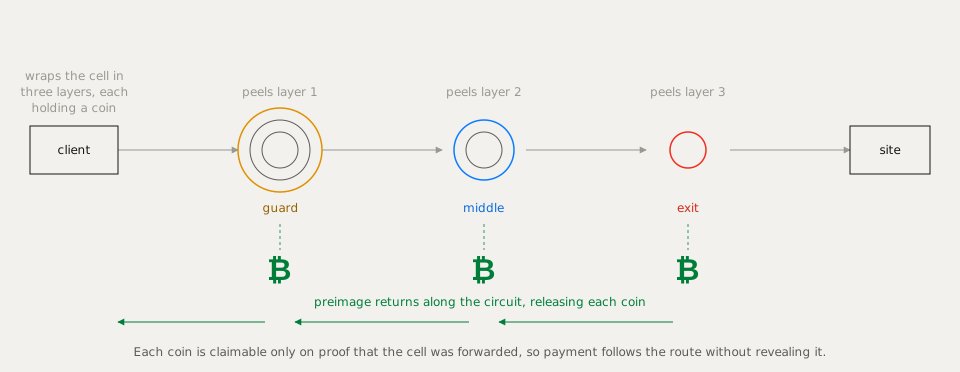
But designing the mechanism exposed a more basic problem: we didn't know how incentives would change who operated relays or why existing operators volunteered in the first place. For an anonymity network, attracting more infrastructure isn't necessarily beneficial if incentives also attract adversarial operators.
Answering that required understanding the people behind the network.
Between the Onion's Layers
For my anthropology capstone, I conducted an ethnography of Tor relay operators. I interviewed operators across several countries, studied Tor's mailing lists and technical debates, and spent three months running an exit relay from UVA's computer science department.
Operating an exit relay quickly made the social infrastructure around Tor tangible. Within ten days, UVA received five copyright takedown notices associated with our IP address. After attacks against an Italian university were traced through the relay, I met with UVA's CIO and negotiated permission to keep it running under a more restrictive exit policy.
The research showed a network held together by more than protocol. Relay operators had their own motivations, norms, institutions, and informal systems of accountability. Technical expertise acted as both a barrier to participation and part of the culture that sustained the network, while critical functions such as Tor's directory authorities remained concentrated among a small number of trusted operators.
The project changed how I thought about incentives in decentralized systems: before designing a mechanism to change people's behavior, you need to understand the social system already producing it.