In 2018 I began working with a collective of web3 developers that wanted to operate fully onchain. Pretty soon we realized that to contract with clients without taking on personal liability, we would need a legal entity of some kind. That sent me looking for a way to give a DAO legal recognition and protection without giving up the qualities that made it a DAO.
dOrg, the first limited liability DAO
Oliver Goodenough had designed the Blockchain-Based Limited Liability Company, which Vermont passed into law in 2018, letting a company reference blockchain code as the source of its governance. He worked with us to design a legal structure that used it, and we formed dOrg LLC in May 2019. dOrg was recognized at the time as the first legal entity whose operations and ownership were managed entirely onchain.

 CoinDeskdOrg Founders Have Created the First Limited Liability DAO
 CointelegraphdOrg LLC Purports to be First Legally Valid DAO Under US Law
We published the guidelines and templates with the aim of making a legally registered DAO as easy to set up as a social media account, and I was invited to speak about what we had learned so that others could build on it.
 GitHub
The DAO Model Law
In 2020 I joined COALA, the Coalition of Automated Legal Applications, to help draft a model law that any jurisdiction could adopt. As the core non-lawyer in the working group, I brought my practical experience from dOrg to the task of working out how to extend legal protection to DAO participants in a way that aligns with a jurisdiction's public policy goals. Utah and New Hampshire have since recognized DAOs as legal persons in acts drawn from it, and COALA is still working with other jurisdictions interested in the framework.
 COALA
COALAWyoming's blockchain bill
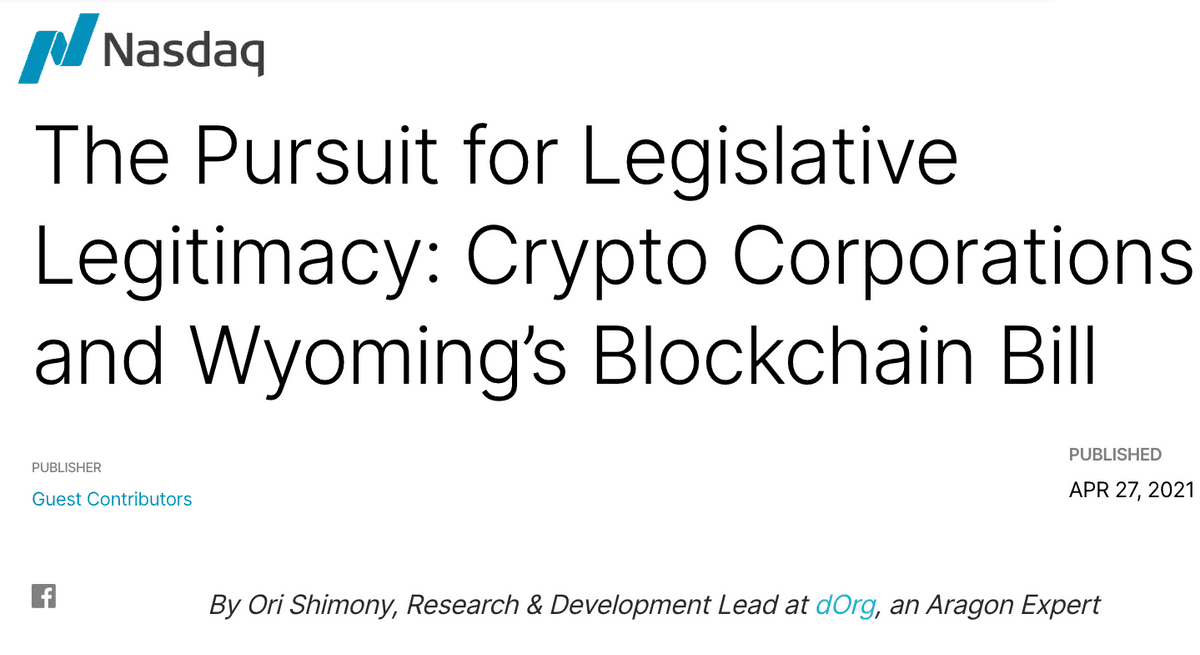
When Wyoming let DAOs incorporate as LLCs in 2021, I wrote for Nasdaq on what it missed. The shield mattered, but the bill regulated DAOs as though they were more efficient corporations, which constrains every use that looks nothing like one: political action committees, universities, municipalities, data unions and platform co-ops.
 Nasdaq
Where it stands
What we had to invent in 2019 is now routine. DAO statutes have since appeared in jurisdictions on several continents, and from DeFi summer in 2020 onward a legal entity became a standard part of the stack, set up alongside the contracts as a matter of course.